The South Brickell bayfront corridor (roughly from Brickell Avenue south to Coconut Grove along Biscayne Bay) has emerged as one of the most supply-constrained luxury submarkets in Miami. With limited developable bayfront parcels remaining and several major projects nearing completion, the investment dynamics here are different from what you’ll find in Edgewater, downtown, or even the Brickell core. Here is a market-level analysis.
What Defines the South Brickell Bayfront Corridor?
This corridor occupies a specific stretch of Miami’s bayfront between the dense Brickell financial district to the north and the residential neighborhood of Coconut Grove to the south. What makes it distinctive (and what drives its investment thesis) is a combination of three factors that are difficult to replicate:
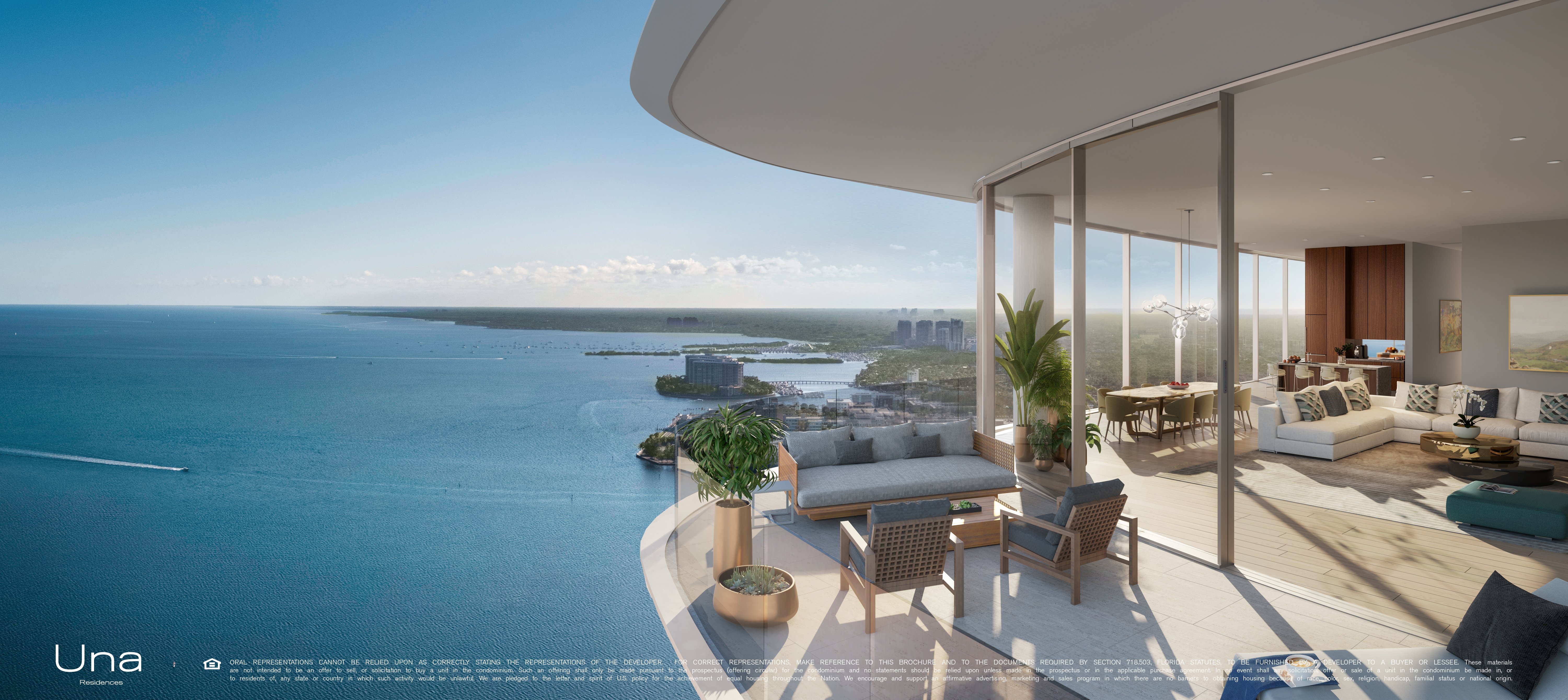
Direct bayfront exposure. Unlike much of Brickell proper, where towers sit on interior blocks separated from the water by roads and other buildings, the South Brickell bayfront properties have unobstructed water frontage. That’s not just an aesthetic preference. It’s a fundamental scarcity driver.
Limited remaining development parcels. The number of undeveloped bayfront sites in this corridor is finite and dwindling. Once the current pipeline of projects is built, there are very few (if any) comparable sites available for new development. Una Residences sits on one of these last parcels.
Proximity to both urban and residential lifestyle. You’re 5 minutes from Brickell City Centre, 8 minutes from Coconut Grove, and 10 minutes from Key Biscayne. That triple-proximity is something buildings further north (downtown, Edgewater) or further south (deep Coconut Grove) can’t match.
How Has Pricing Evolved in This Corridor?
The South Brickell bayfront has seen meaningful price appreciation over the past several years, driven primarily by the wave of ultra-luxury new construction that’s replaced older, lower-density properties along the water. Past results do not predict future results.
A useful comparison starts with the residence itself: interior area, floor level, orientation, and the current asking price. Request current pricing and availability through the pricing page.
For comparison, the broader Brickell market (including interior blocks without water frontage) trades at a wider range, with new construction starting lower for non-waterfront product. The premium for direct bayfront exposure in this corridor is substantial, and historically, that premium has only grown as available bayfront inventory has decreased.
What Is the Current Supply Picture?
This is where the market gets interesting. The South Brickell bayfront has a limited number of active projects at various stages:
Delivered residences: Una Residences contains 135 residences and was delivered in 2026. Buyers can inspect the completed residence, finishes, and views. Request current availability for the home under consideration.
Under construction: Several branded and non-branded developments along the Brickell corridor are at various construction stages. These include projects by major developers with delivery dates ranging from 2026 to 2028+.
Pre-construction/Early sales: A new generation of branded residences: including St. Regis Residences, Waldorf Astoria, and Cipriani, are in various pre-construction stages along the broader Brickell corridor. While not all are bayfront, they represent the competitive supply picture that buyers should understand.
The key insight: the pipeline of bayfront-specific product is much smaller than the overall Brickell pipeline. There are dozens of towers planned for Brickell, but only a few will actually sit on the water. That distinction matters enormously for long-term value.
How Does This Corridor Compare to Other Miami Submarkets?
Buyers considering South Brickell bayfront typically also look at three other submarkets:
Coconut Grove: This is a separate neighborhood to compare with South Brickell. Start with the exact residence plan and the surrounding area rather than a neighborhood-wide price claim.
Comparing neighborhoods: Review each project's actual waterfront position, residence plans, and ownership terms. The Una neighborhood page focuses on this building's South Brickell setting.
Bayfront and oceanfront: Una's developer materials place the building on Biscayne Bay. Compare the water setting and the practical use of each residence before narrowing a search.
What Is the Investment Case for South Brickell Bayfront?
I talk to investors every day who are trying to decide between different Miami submarkets. Here’s why the South Brickell bayfront corridor keeps coming up in those conversations:
Supply constraint is permanent. You can build more towers in Edgewater or downtown. You cannot create more bayfront land in South Brickell. The parcels that exist are either already developed or in the current pipeline. When those projects deliver, the supply of new bayfront product in this specific corridor effectively goes to zero until someone redevelops an existing building. Which is decades away.
Demand is diversifying. The buyer pool for South Brickell bayfront has expanded significantly. It’s no longer just domestic retirees and Latin American investors. The post-2020 migration brought tech executives, finance professionals, and family offices from New York, California, and Chicago. That broader demand base supports pricing.
Compare the actual residence. Brand names alone do not establish a comparable sale. Review current unit-level information with the corresponding plan.
Delivered buildings reduce risk. For buildings like Una Residences that are already delivered, buyers eliminate the construction-stage uncertainties that come with pre-construction purchases: delays, cost overruns, developer defaults, or changes to the final product. You’re buying what you can see, touch, and verify.
What Should Buyers Watch For?
No market analysis would be complete without acknowledging the risks and variables that could affect this corridor’s performance:
Interest rates and financing costs: Even at the ultra-luxury level, many buyers use financing. Changes in rate environment affect monthly carrying costs and can slow absorption in the broader market, even if cash buyers are less affected.
Insurance costs: Florida’s property insurance market has been challenging. While luxury bayfront buildings typically have superior construction and lower risk profiles, insurance costs are a line item that every buyer should factor into their total cost of ownership.
Condo supply in broader Brickell: While bayfront supply is constrained, the broader Brickell market has a significant pipeline. If the non-waterfront market softens due to oversupply, it could create short-term pricing pressure on the corridor. The counterargument is that bayfront and non-bayfront product serve different buyer segments, but the markets aren’t entirely independent.
Global capital flows: Miami’s luxury market is significantly influenced by international buyers, particularly from Latin America and increasingly from Europe and the Middle East. Geopolitical shifts, currency fluctuations, and changes to foreign investment regulations can affect demand patterns.
None of these risks are unique to South Brickell, they apply to the Miami luxury market broadly. The corridor’s structural advantages (permanent supply constraint, location, and design pedigree of the current product) provide a cushion that less supply-constrained markets don’t have.
For a personalized investment analysis based on your specific criteria, contact me directly. I can model scenarios for individual buildings and unit types across the corridor.